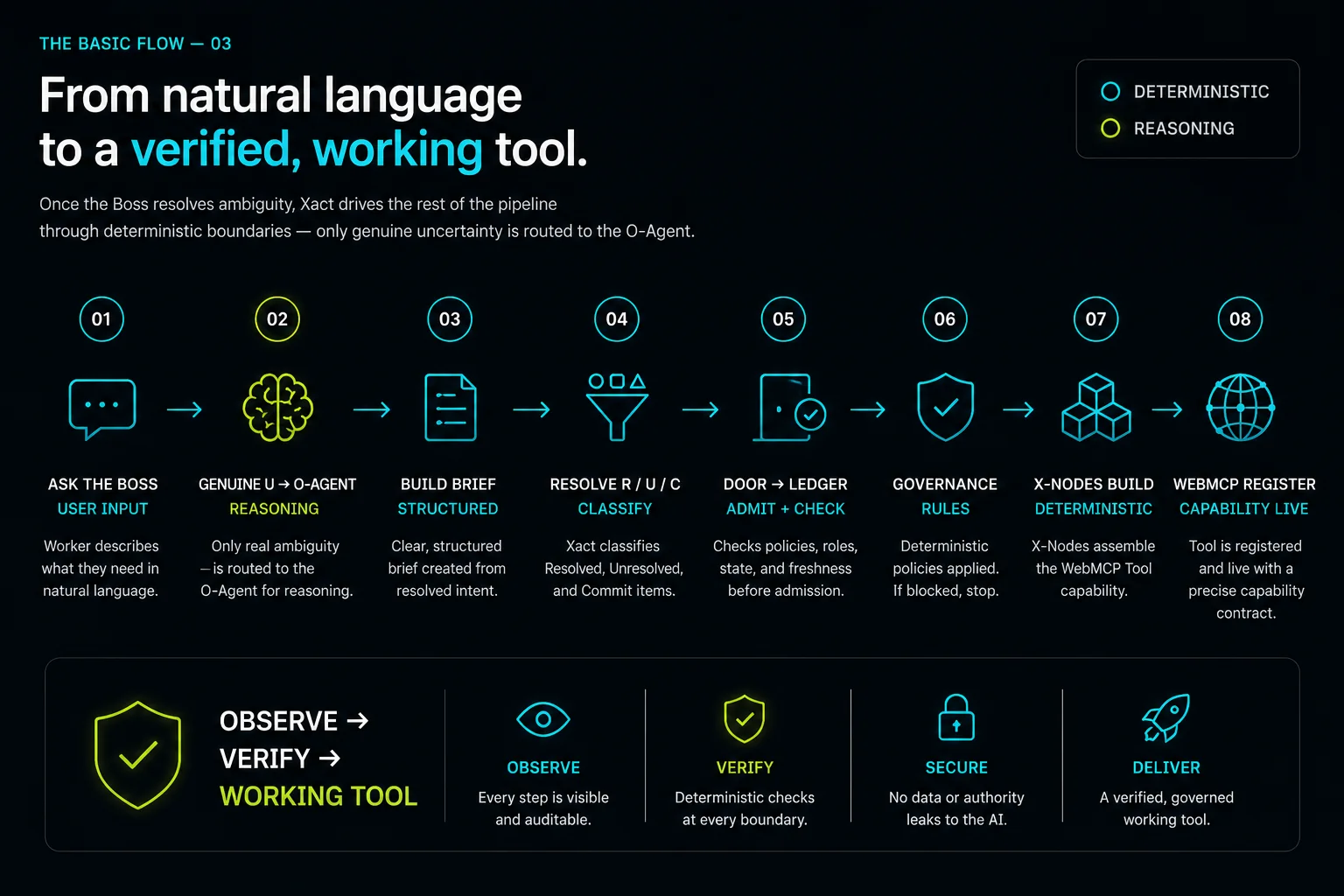
01 · THE FLOW
From ordinary language to a verified capability.
The worker starts with a request, not a tool name. Xact turns that request into a structured brief, checks its meaning and boundaries, and sends only genuine uncertainty to the Boss.
 XACT FOUNDRYCHATGPT APP CHECKING MCP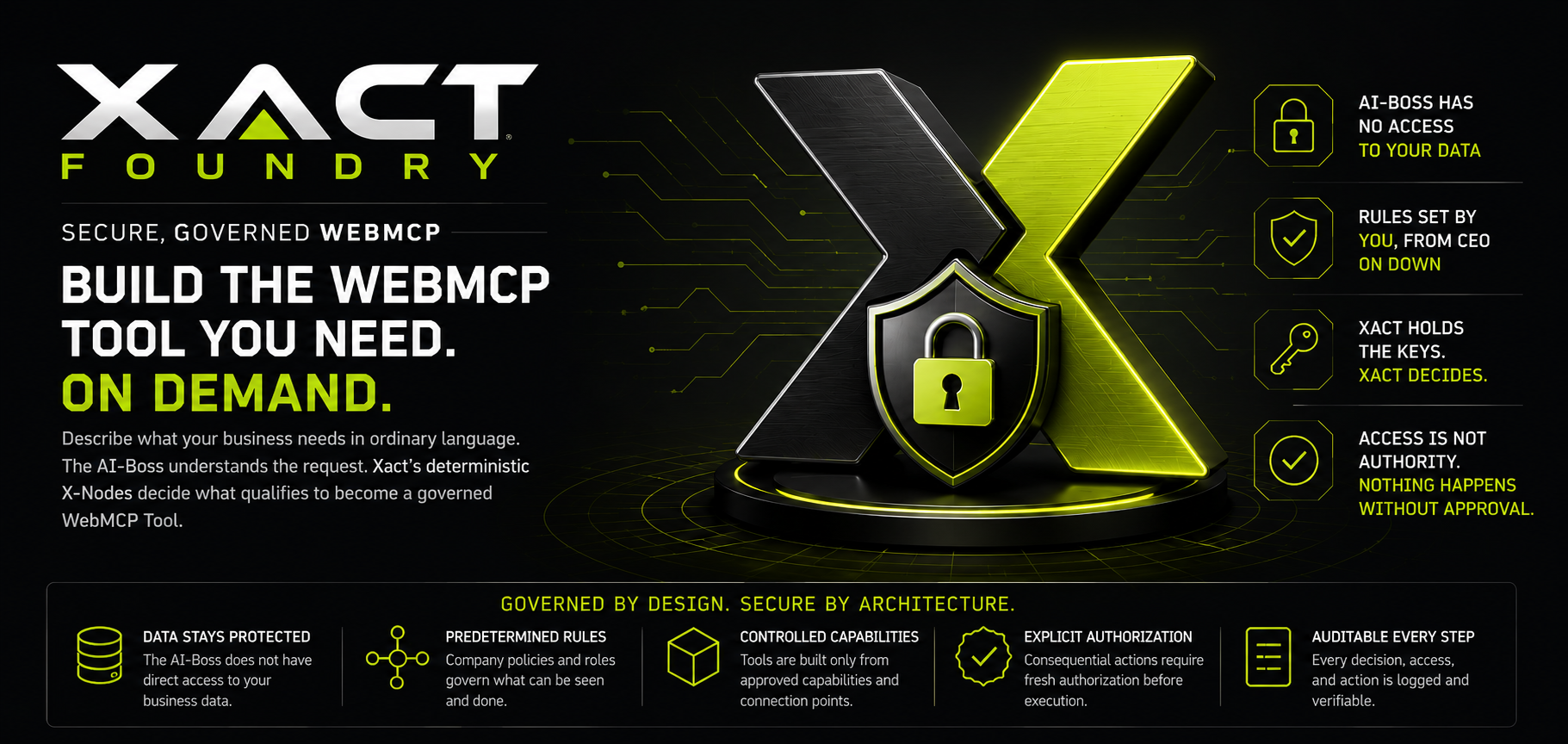
BUILT FOR EVERY INDUSTRY
Built for every industry. Xact Foundry is not limited to one workflow. The same governed construction model can produce public-safe tools for trading, healthcare, logistics, manufacturing, cybersecurity, real estate, education, insurance, HR, and energy operations. Describe the need in ordinary language; Xact determines what may become a tool, which data and policies apply, and whether execution requires a fresh Commit.
The worker starts with a request, not a tool name. Xact turns that request into a structured brief, checks its meaning and boundaries, and sends only genuine uncertainty to the Boss.
Every request is checked against approved vocabulary, data scope, policy, and authority. If a required concept is missing or unsafe, Xact explains the boundary instead of inventing a tool.
Once intent is governed, Xact gets the language model out of the way. Deterministic X-Nodes execute exact work at machine speed—averaging 9 μs per decision and ~109,500 decisions per second, with zero LLM inference tokens on the deterministic path. The result is simple: use intelligence where reasoning is needed, and use Xact everywhere the work is already exact.
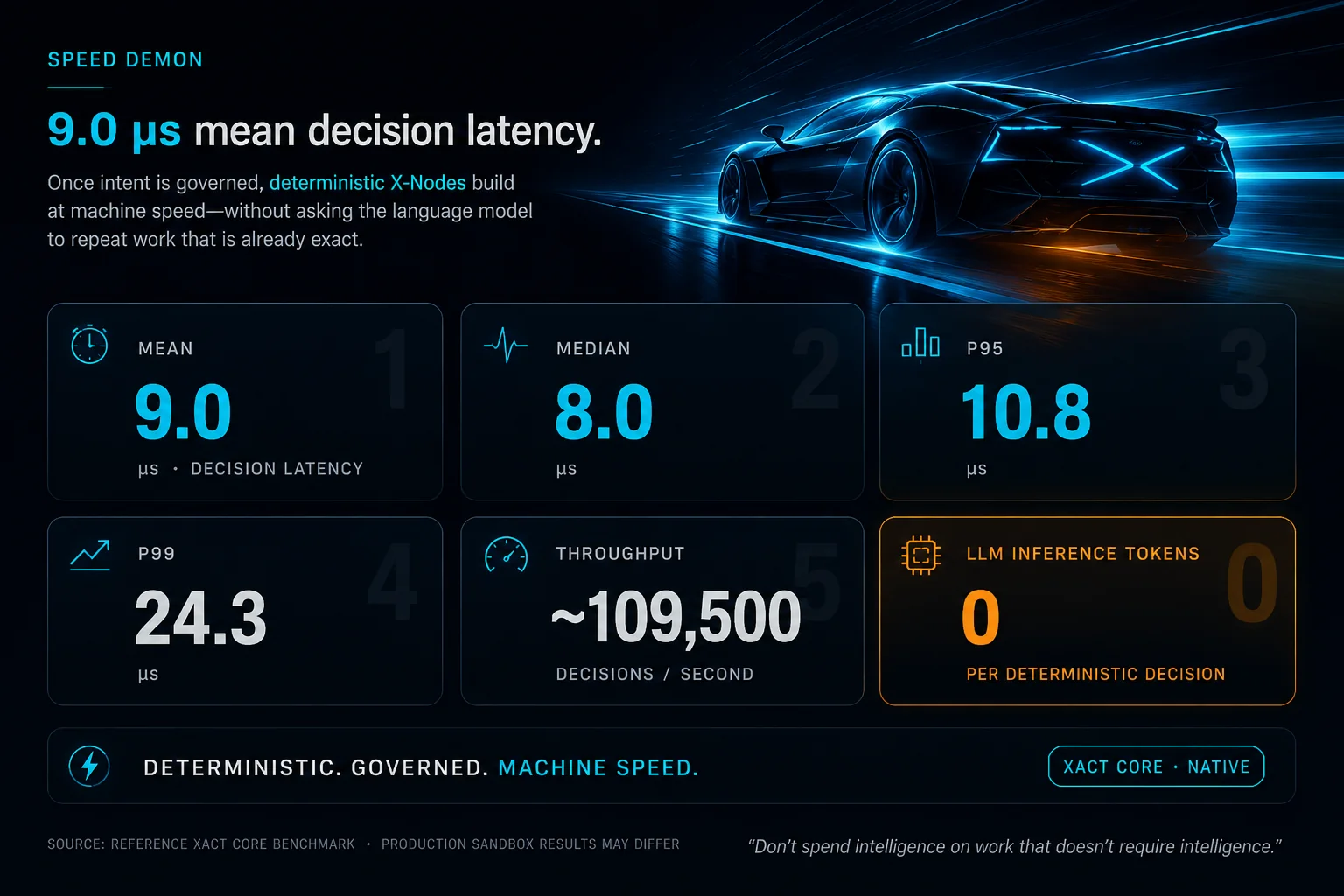
Once a capability is governed, the X-Nodes run the repeatable construction path without further model inference. The reference measurements are labeled separately from the browser demo.
ChatGPT can propose structure, but it cannot grant itself access. Construction, execution, and consequential Commit remain separate steps, with evidence and authorization checked at each boundary.
ChatGPT understands and proposes. Xact governs what may be built, what may run, and what requires a fresh Commit.
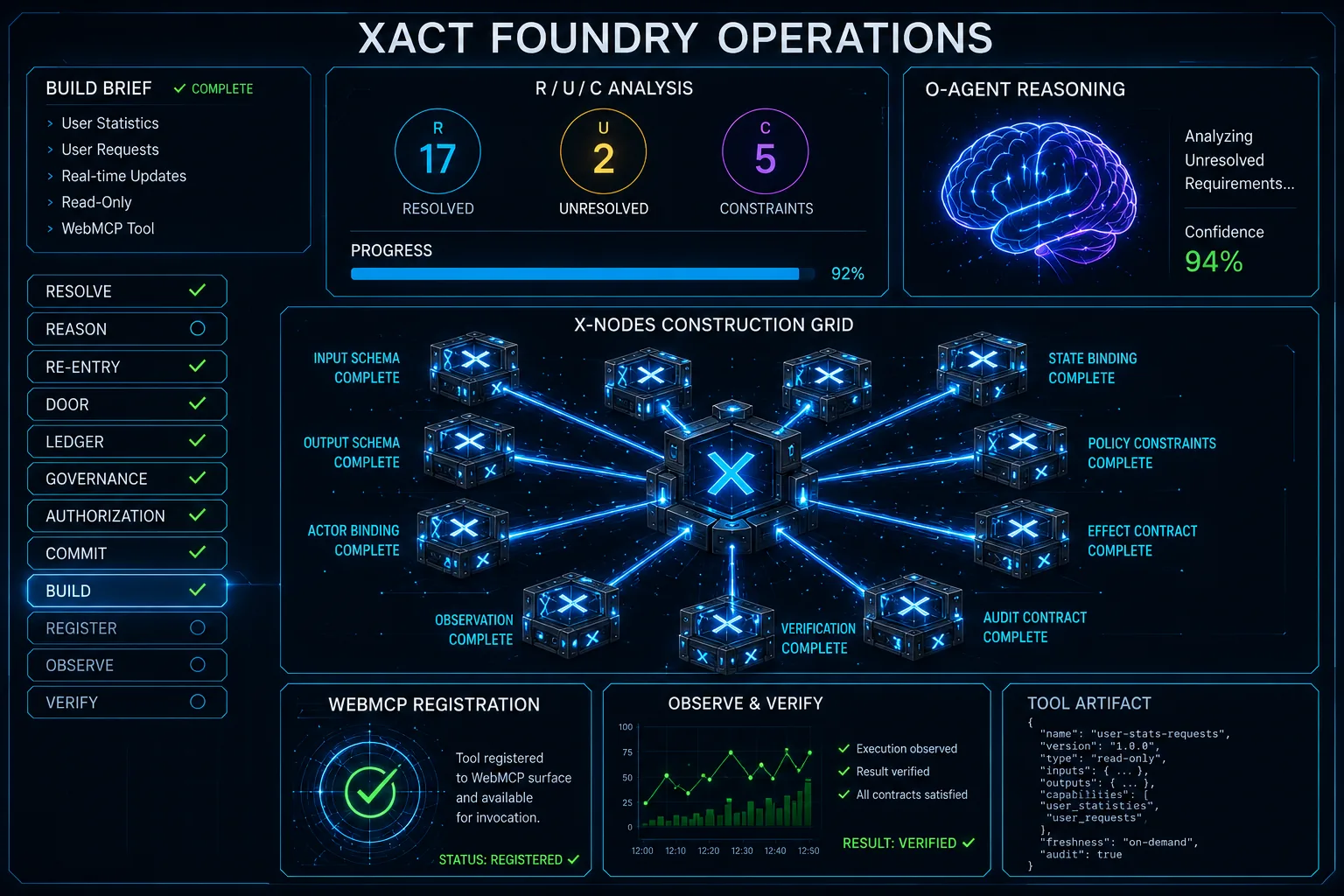
Resolution, reasoning, re-entry, authorization, Commit, build, registration, observation, and verification remain distinct and auditable.
BOUNDED REASONING LOOP
The bridge resolves declared equivalents first, asks one concise question for close matches, and reserves ChatGPT reasoning for genuine semantic U—without inheriting execution or Commit authority.
Xact validates the response, rejects off-list choices, and preserves normal construction and Commit controls.
1. Ask for examples by category. 2. Choose or edit a prompt. 3. Ask Xact to construct it. 4. Review the governed result. 5. Ask for the approved read/report when a runtime handler exists.
Challenge scope: governed capabilities are chat-scoped. Reopen the Xact Foundry conversation from the ChatGPT sidebar to reuse them. Dashboard history is future productization.
CONSEQUENCE BOUNDARY
This public app exposes governed tool contracts and a bounded Boss reasoning loop. It does not expose private Xact internals, execute external actions, or grant ChatGPT Commit authority.
EXPLORE THE PUBLIC XACT WEB SANDBOX ↗GOVERNED MUTATIONS
These examples show how Xact keeps construction, authority, and consequence separate.
The contract records the actor, eligibility rules, credit limits, freshness, and audit requirements. A fresh Commit is required for each issuance.
Reassignment is allowed only when the owner is unavailable or the required skill mismatches. Confirmation, audit, and fresh Commit remain required.
In public-safe demo mode, the contract is inert because no execution handler is attached. No employee record changes.
Xact constructed a governed definition and passed its checks. It does not claim that data was read or that an external consequence occurred.
The trace covers intent, R / U / C classification, reasoning evidence, policy and state checks, Commit outcome, execution route, verification, and final result. Production deployments can bind this to authenticated identities and immutable audit storage.
X-Nodes perform narrowly defined deterministic work inside governed boundaries. They accept approved inputs, apply explicit rules, and fail closed when evidence, state, or authority is missing.
No. Limits are defined by the organization’s approved policy. Demo ceilings are examples, not universal Xact rules.
“Built and validated: issue_service_credit.”Inert governed contract · no credit issued
“Built and validated: reassign_support_ticket.”Inert governed contract · no ticket changed
“Sage Bennett’s status was not changed.”Contract-only in public-safe demo mode